
What Makes Cannabis Strains Purple or Pink? Genetics, Anthocyani
Purple strains are purple because they can make and store visible anthocyanin pigments in their flower tissues. Genetics establishes that capacity; flowering stage, temperature, and the individual phenotype influence how much of it you actually see. Pink is usually the lighter, less saturated end of that same visual range, but cannabis research has not yet mapped every pink-flower expression as neatly as growers would like. The practical takeaway is simple: start with seed stock selected for color, grow it well, and treat late-flower cooling as a possible expression tool—not as a substitute for purple genetics.
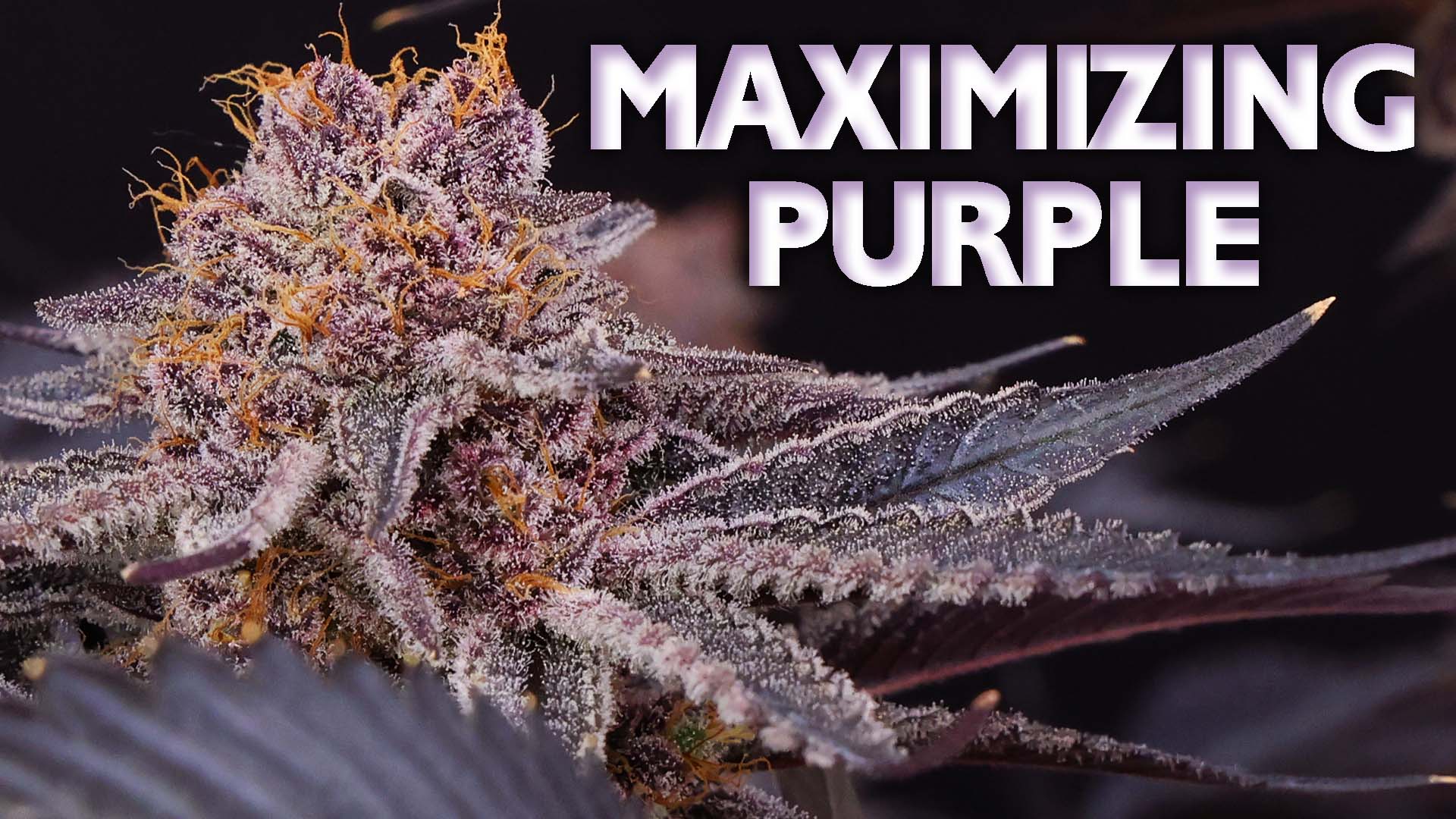
The short answer: purple is anthocyanin showing through
Anthocyanins are water-soluble flavonoid pigments held in plant-cell vacuoles. In cannabis, researchers have chemically identified cyanidin-3-rutinoside, also called keracyanin, as the major anthocyanin found in purple leaf, stem, and flower tissue.[1] A separate study of colorful cannabis varieties found that several genes in the flavonoid/anthocyanin pathway tracked closely with anthocyanin accumulation.[2]
That is why a truly purple plant does not need to be starved, damaged, or frozen to have color. It has the biochemical equipment to accumulate pigment. Environmental conditions can alter the amount, timing, and visibility of that pigment, but they cannot reliably turn a genetically green line into a deeply purple flower line.
Genetics comes first, but seed-grown color is still a phenotype question
“Purple” is not one single trait. One plant may put color into sugar leaves, another into petioles, another into calyxes, and another mainly into the bracts surrounding the flower. Intensity can range from a soft lavender wash to nearly black violet. Two seedlings from the same cross can therefore finish very differently.
For a breeder, the useful selection target is not merely a purple photograph. It is repeatable pigment in the tissue you care about, expressed at normal flowering temperatures, alongside the plant’s structure, resin, aroma, finish time, and fertility. A line that colors only after extreme cold is a weaker color candidate than one that reliably pigments under an otherwise productive environment.
That is also why parent names and lineage are better treated as a starting point than a color guarantee. Learn how recombination changes seed-grown outcomes in our guide to cannabis crosses, and see why selfed seed can concentrate traits without making every plant identical in S1 Cannabis Seeds Explained.
What cooler temperatures can—and cannot—do
Cooler flower conditions can materially affect anthocyanin accumulation in a cannabis plant that already has purple capacity. In a controlled study using an inbred, consistently purple cannabis population, anthocyanin levels peaked at constant 8°C and 15°C, while pigment was lower at 0.5°C and 22°C.[3] That result matters because it disproves the simplistic rule that “colder is always purpler.” Severe cold is not a quality-control setting.
It is equally important to read the experiment in context. The researchers used a day-neutral CBD-type inbred population already selected to develop purple leaves and flowers. Those temperatures were experimental treatments, not a general late-flower recipe for every cultivar. Flower dry weight and CBD percentage rose with temperature across that particular experiment, so the color optimum was not the yield optimum.[3]
| Question | What the evidence supports | What it does not support |
|---|---|---|
| Can cool conditions deepen color? | Yes, temperature can change anthocyanin accumulation in purple-capable cannabis.[3] | A guarantee that every green cultivar will become purple. |
| Is colder always better? | No. The controlled study found a non-linear response, with less pigment at the coldest treatment.[3] | Running a cold, stressed room simply to chase bag appeal. |
| Does purple color prove stronger flower? | No. Pigment, cannabinoid concentration, and flower dry weight responded differently in the study.[3] | Using purple appearance as a potency test. |
Why a plant can look pink instead of purple
Pink is best understood as a visible phenotype, not a single confirmed cannabis mechanism. In practice, lighter pigment concentration, the exact anthocyanin present, where it accumulates, surrounding green tissue, and the stage of the flower can all change the final impression from blush pink to red-violet to dark purple. Anthocyanin color is also influenced by the environment inside the vacuole, including pH and interactions with other compounds; that broad plant chemistry is well established.[4]
But growers should not turn that into a root-zone-pH hack. Vacuolar pH inside a pigment cell is not the same thing as the pH of nutrient solution or runoff. Intentionally pushing root-zone pH outside the appropriate range is much more likely to create uptake problems than a stable pink phenotype. Cannabis-specific pigment research remains incomplete, so claims that a particular nutrient ratio or pH adjustment will reliably “make buds pink” are ahead of the evidence.
Do not confuse pink pistils with purple flower tissue
Pink, orange, or red-looking pistils are visually striking, but they are not the same observation as pigment in calyxes, bracts, or leaves. When evaluating purple strains, inspect the actual flower tissue under neutral light. A plant with colored pistils but green calyxes may still be attractive; it is simply a different trait than a densely purple flower.
For selection work, record color at the same flowering week across plants, photograph the same flower zone, and note room temperatures rather than relying on memory. The most informative comparison is a clone trial: genetically identical cuts in a stable environment versus a modestly cooler finish. That separates inherited tendency from an environmental response far better than comparing unrelated seedlings.
What we know, what growers commonly overstate
- Known: Purple cannabis tissue contains anthocyanin pigments, and cannabis studies have identified both pigment chemistry and candidate biosynthesis genes.[1][2]
- Known: Temperature can affect anthocyanin accumulation, but the relationship is not simply “lower temperature equals more purple.”[3]
- Likely but phenotype-dependent: A genetically purple-capable plant can show stronger or earlier color under a suitable cool finish.
- Not established: That phosphorus starvation, excessive flushing, or deliberately incorrect root-zone pH can create a desirable purple genotype.
- Not established: That purple color predicts THC, CBD, terpene content, yield, or smoke quality. The available temperature study specifically measured CBD-type plants and cannot be stretched into a claim about all chemotypes.[3]
Choosing purple strains without buying a photo
Shop color genetics as part of a whole plant, not as a promise that every seed will match a marketing image. Begin with the Selfie Seeds™ cannabis seed collection, then read the stated cross and decide whether you are prepared to hunt a phenotype. The cataloged PURPLE BERRY cross combines Strawberry Sugar and Blueberry Sugar, while PURPLE BERRY CBD adds Charlotte’s Angel to that lineage. Those names and parent combinations make them relevant starting points for growers pursuing colorful, fruit-forward selections; they are not a substitute for growing and selecting the individual plant.
If aroma is your deciding trait as much as appearance, use our guide to how we judge sweet cannabis strains alongside the color search. The keeper is the plant that repeats the combination you value—color, flower quality, aroma, vigor, and finish—not the one that happened to look purple in one late-season photograph.
Bottom line
Genetics supplies the pigment potential. Phenotype determines how that potential sorts out in an individual seedling. Environment can help reveal it, especially during flowering, but stress is a poor replacement for selection. If your goal is reliably purple or pink cannabis, select from purple-capable families, keep accurate flower-stage and temperature notes, and favor plants that color well without sacrificing the rest of the crop.
Sources & References
Source hierarchy prioritizes documented HWGrow/EVYGrows/SelfieSeeds experience. External evidence is supplemental where useful, with counterarguments included when relevant.
- [Peer-Reviewed Journal] When Cannabis sativa L. Turns Purple: Biosynthesis and Accumulation of Anthocyanins
Bassolino, L.; Pizzamiglio, V.; et al. · Antioxidants · 2023
Quoted source: ““Cyanidin-3-rutinoside (keracyanin) was identified as the major pigment””
Supports / context: Cannabis flower, leaf, and stem pigmentation includes anthocyanins; keracyanin was identified as the major pigment in purple tissues. - [Peer-Reviewed Journal] Leaf pigmentation in Cannabis sativa: Characterization of anthocyanin biosynthesis in colorful Cannabis varieties
Huebner, M.; et al. · Plant Direct · 2024
Quoted source: ““Anthocyanins are largely responsible for the red/purple color phenotypes in plants.””
Supports / context: Candidate genes in the cannabis flavonoid and anthocyanin pathway correlate with anthocyanin accumulation. - [Peer-Reviewed Journal] Anthocyanin accumulation, inflorescence dry weight and total cannabidiol content have different temperature optima in Cannabis sativa
Kim, J.; et al. · Journal of Cannabis Research · 2025
Quoted source: ““Anthocyanin accumulation was significantly affected by temperature stimuli””
Supports / context: In a selected purple, day-neutral cannabis population, anthocyanin accumulation peaked at 8°C and 15°C and was lower at 0.5°C and 22°C. - [Peer-Reviewed Journal] Anthocyanin stability and degradation in plants
Liu, Y.; et al. · Frontiers in Plant Science · 2022
Quoted source: ““The stability and color of these pigments depend on the specific external conditions of the vacuole””
Supports / context: General plant evidence that anthocyanin appearance is influenced by vacuolar conditions, including pH, co-pigments, and metal interactions; this does not establish root-zone pH as a cannabis color tool.
Related seeds for sale
PURPLE BERRY CBD - Strawberry Sugar x Charlotte's Angel x Blueberry Sugar · Blueberry Sugar - Blockhead Selfie Seeds™ · SAND BERRY - (SB x WW) x Strawberry Sugar · PURPLE BERRY - Strawberry Sugar x Blueberry Sugar
Related Products
PURPLE BERRY CBD - Strawberry Sugar x Charlotte's Angel x Blueberry Sugar
$75.00 Ex Tax: $75.00
Blueberry Sugar - Blockhead Selfie Seeds™
$100.00 Ex Tax: $100.00


SAND BERRY - (SB x WW) x Strawberry Sugar
$75.00 Ex Tax: $75.00


PURPLE BERRY - Strawberry Sugar x Blueberry Sugar
$100.00 Ex Tax: $100.00