
Why Do Cannabis Plants Herm? Causes, Early Signs and What to Do
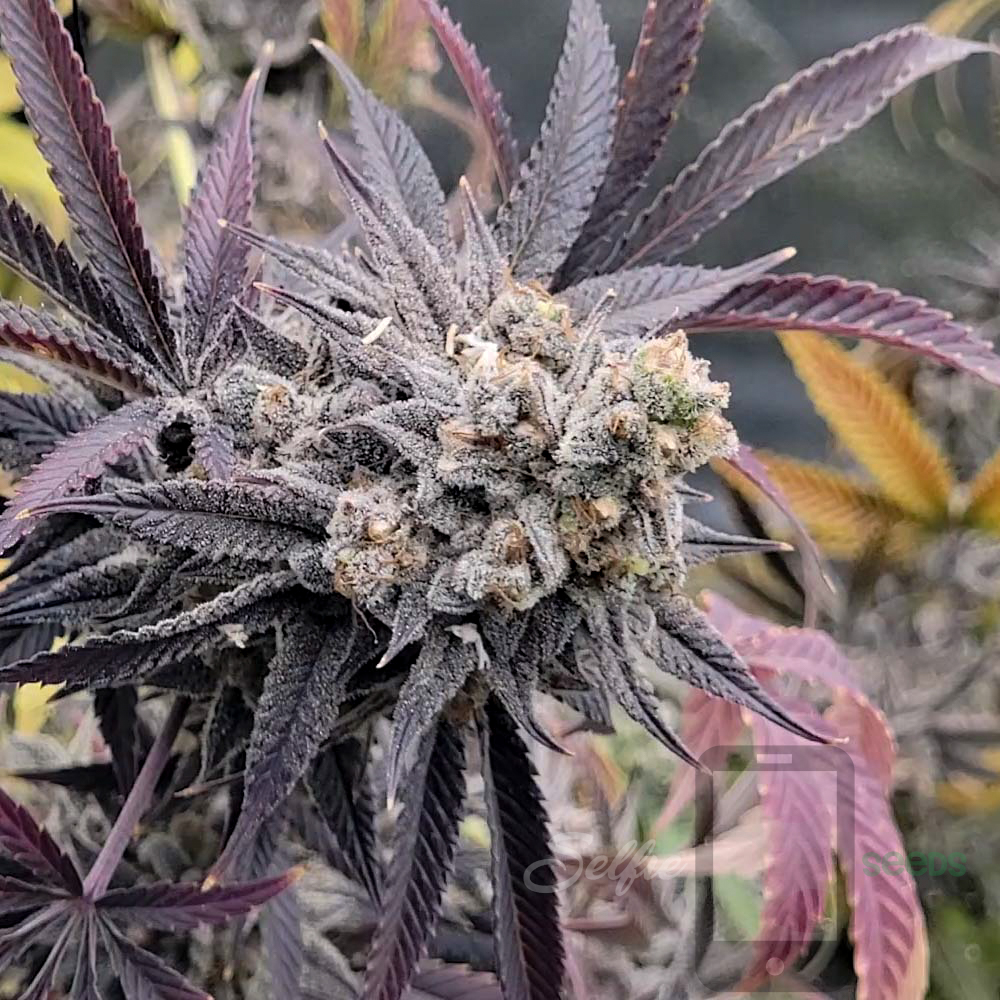
Why do cannabis plants herm? A cannabis plant may develop both female and male reproductive structures—usually called “herming” by growers—because sex expression is influenced by genetics, development, growing conditions and, in breeding, deliberate chemical sex reversal. The practical concern is simple: viable pollen from anthers or pollen sacs can fertilize female flowers and create seeds.[1][2]
The cause is not always diagnosable from one plant. A light interruption, heat event or hard dry-back may be worth investigating, but it is usually more accurate to say that a plant expressed intersex traits after a stress event than to claim that event definitively caused it. Research supports a multi-factor explanation, while the exact mechanisms behind spontaneous intersex expression remain unresolved.[1][2]
If you are selecting material for another run, start with the broader cannabis seeds collection. For seed lines, lineage, the specific parent plant and the conditions under which it was evaluated are more useful than a strain name or a “feminized” label alone.
What does “herm” mean in cannabis?
“Herm” is informal grower shorthand. In practice, people use it for a mostly female plant that develops male reproductive structures. Those structures may be obvious pollen sacs at nodes or individual exposed anthers inside a female flower.
- Pollen sacs: rounded structures, often on short stems, that can form in clusters and open to shed pollen.
- Anthers (“nanners”): narrow yellow-to-lime structures that may emerge directly from a female flower. In a study of marijuana inflorescences, anthers on hermaphroditic flowers produced pollen with morphology and germination behavior similar to anthers from male flowers.[1]
- Normal female flower parts: stigmas/pistils are hair-like and may be white, cream, orange, red or brown. A swollen bract/calyx is also normal female-flower development; it is not automatically a pollen sac.[1]
One late anther is not the same as repeated clusters of pollen sacs early in flower. Treat both as a pollination risk, but do not assume they have the same cause or breeding significance.
Why cannabis plants herm: what is known, and what is assumed
1. Genetic susceptibility and plant-to-plant variation
Genetics matter, but “this cultivar always herms” is usually a stronger claim than the evidence can support. Cannabis sex expression involves chromosomal, hormonal and environmental regulation; plants within the same named line can still respond differently.[2]
Practical breeding interpretation: if an otherwise well-managed plant repeatedly produces substantial male structures, especially early in flower, many breeders would exclude it from a stability-focused seed project. That is a selection decision, not proof that one gene or one stressor caused the expression.
For a clearer explanation of how parentage changes expectations, see how strain crosses differ.
2. Interrupted nights and inconsistent flowering conditions
Checking for light leaks, timer errors and unexpected room light is worthwhile whenever a flowering plant begins throwing male structures. Cannabis flowering is photoperiod-sensitive, and a dependable dark period is basic grow-room practice. But published evidence does not let a grower diagnose every intersex event as “caused by a light leak.” Treat it as an important correctable variable, not a guaranteed explanation.[2]
Inspect the room during the scheduled dark period. Fix timer problems, zipper gaps, indicator lights and light entering from adjacent spaces. Once corrected, avoid repeatedly changing the schedule while the plant finishes.
3. Severe or cumulative stress
Environmental and physiological stress are repeatedly discussed as contributors to unstable sex expression, alongside genotype and developmental stage.[1][2] In a real garden, that may include overheating, drought, root restriction, poor drainage, pest or disease pressure, or abrupt changes to irrigation and feeding.
The key limitation: an individual plant can experience stress without producing anthers, while another plant may express them under conditions that look ordinary. That is why notes matter. Record the plant, flower week, symptoms and any unusual event instead of relying on a single-cause diagnosis.
4. Damage or major work during flower
Heavy defoliation, broken branches, late transplanting, pest damage and aggressive corrective measures all add stress. Major training is generally easier to recover from before flowering or in early flower. If intervention is necessary later, make the smallest useful correction and return the plant to steady conditions.
5. Very late flowers
Growers often describe a few late-flower anthers as a last attempt to reproduce. That observation can be useful for harvest decisions, but it should not be mistaken for a settled biological diagnosis: the mechanism behind spontaneous hermaphroditic expression is still poorly understood.[1] Late anthers can still shed viable pollen, so inspect nearby flowers rather than dismissing them.
Are feminized or S1 seeds more likely to herm?
Not inherently. Feminized seed is produced using pollen from a genetically female plant, so the resulting seed is expected to lack a Y chromosome and produce predominantly female offspring.[1][2] That production method is not the same thing as accidental intersex expression in a flower room.
What matters is the parent-selection and testing process. A breeder can select parents that hold stable female expression under the conditions used for evaluation, but no breeder can promise that every seed-grown plant will respond identically in every environment.
S1 means a selected plant was selfed; it does not mean every offspring is a clone or that the seeds are automatically “herm seeds.” Selfing can concentrate traits from one parent while still allowing variation and recessive traits to appear. Selfie Seeds™ explains that distinction in S1 cannabis seeds explained: what selfing does to a phenotype. If you want to explore documented selfed lines, browse True Selfies.[3]
How to spot a herm early
- Inspect nodes after the flip. Look where branches meet the main stem and around new flower sites.
- Check dense flowers, not only the canopy. Gently separate buds and look for smooth yellow anthers or clusters of rounded sacs.
- Use a close phone photo or hand lens. It is often the quickest way to distinguish an anther from a swollen female bract.
- Reinspect after disruptions. Check again after a timer failure, heat spike, severe dry-back, pest outbreak or major physical damage.
- Keep a plant-specific record. Note flower week, location, how many structures appeared and what changed in the environment. This is more useful than writing “hermed” with no context.
What to do when you find pollen sacs or nanners
Your decision should reflect the amount of expression, whether pollen has opened, how far along the flowers are, and how important a seedless crop is to you.
| What you find | Practical response |
|---|---|
| One or two isolated, unopened anthers or sacs | Remove them carefully with clean tools, bag the material, and inspect that plant and its neighbors daily. Correct obvious environmental problems, but do not overcorrect with several major changes at once. |
| Repeated nanners across several flowers | If possible, isolate the plant. Decide whether the time left to harvest justifies daily removal and monitoring, knowing that missed anthers may pollinate nearby flowers. |
| Multiple pollen sacs, especially early in flower | For a sinsemilla crop, removing the plant is often the lowest-risk choice. Avoid shaking or carrying open sacs through the flowering area. |
| Open sacs or visible pollen | Handle the plant gently to limit spread, clean the area after removal, and keep checking all flowering plants for new anthers and developing seed. Hermaphroditic anthers can produce viable pollen.[1] |
Do not assume the plant is safe because the first structure was removed. Continue checking until harvest. Also, do not remove every swollen calyx you see: swelling bracts and changing stigma color are normal parts of female-flower maturation.[1]
How to lower risk on the next run
- Test timers and light-proof the flowering space before the flip.
- Keep irrigation, root-zone conditions and temperature changes as steady as practical.
- Finish major training before flower or early enough for recovery.
- Inspect every cultivar and every individual plant; do not assume one stable plant proves a whole line is stable.
- Log any intersex expression before deciding whether to keep a clone or use a plant in breeding.
- If stability is the priority, avoid breeding from plants that repeatedly express male structures without a clearly exceptional event.
- When comparing seed options, favor clear parentage and documented plant history over broad promises.
Bottom line
Cannabis plants herm because sex expression is not controlled by a single switch. Genetics, developmental stage, environment and plant physiology can interact, and the reason for one plant’s expression is often uncertain.[1][2] The useful response is not panic or blame: identify the structure correctly, limit pollen spread, inspect the rest of the garden, correct avoidable instability, and keep notes that help you make better selection decisions next run.
Sources & References
Source hierarchy prioritizes documented HWGrow/EVYGrows/SelfieSeeds experience. External evidence is supplemental where useful, with counterarguments included when relevant.
- [Peer-Reviewed Journal] Hermaphroditism in Marijuana (Cannabis sativa L.) Inflorescences – Impact on Floral Morphology, Seed Formation, Progeny Sex Ratios, and Genetic Variation
Zamir K. Punja; Janesse E. Holmes · Frontiers in Plant Science · 2020
Quoted source: ““the mechanism for this is poorly understood.””
Supports / context: Supports the distinction between anthers and normal female-flower structures, evidence that hermaphroditic anthers can produce viable pollen, and uncertainty around the mechanism of spontaneous intersex expression. - [Peer-Reviewed Journal] Hermaphroditism in Cannabis sativa L.: Impacts, Inducers, and Industry Implications
Chaylen Douglas Richards; Byeong-Ryeol Ryu; Gyeong-Ju Gim; Sang-Hyuck Park · Plants · 2026
Quoted source: ““sex expression is highly plastic””
Supports / context: Supports the multi-factor framing: genetic, hormonal, developmental and environmental influences all contribute to cannabis sex expression and intersex risk. - [HWGrow / Owner Source] S1 Cannabis Seeds Explained: What Selfing Does to a Phenotype
Selfie Seeds™ / HWGrow · Selfie Seeds™ · 2026
Quoted source: ““greater genetic focus, not literal cloning.””
Supports / context: Supports the site-specific explanation that S1 seed is selfed seed, not a guarantee of genetically identical offspring, and that parent documentation is important.
Related seeds for sale
GUTSO - Strawberry Banana x White Wedding · Selfie Seeds™ Salvage/Eternity/Genetic Purification Service · Strawberry Sugar - White Wedding V2 Selfie Seeds™ · White Sativa Selfie Seeds™
Related Products


GUTSO - Strawberry Banana x White Wedding
$60.00 Ex Tax: $60.00


Selfie Seeds™ Salvage/Eternity/Genetic Purification Service
$3,000.00 Ex Tax: $3,000.00


Strawberry Sugar - White Wedding V2 Selfie Seeds™
$100.00 Ex Tax: $100.00


White Sativa Selfie Seeds™
$75.00 Ex Tax: $75.00